
Health Savings Account - Does it make sense for you?
Hello everyone! Welcome back to another edition of Written by A(ndrew) I(ntelligence). Today I will be discussing the Health Savings Account, who can open one, how they are used, how to compare them to other health insurance plans, and some common misconceptions. Let’s get started!
What is an HSA?
A Health Savings Account (HSA) is a tax-advantaged account where plan members can contribute money to be used for future health care expenses. Contributions are pre-tax, meaning they lower your taxable income for the year. Your contributions to the account can be invested, those investments within the accounts grow tax free, and when it comes time to withdrawal the money for your future healthcare expenses, the distributions are taken out tax free as well. This account offers a coveted triple tax advantage and is arguably the most tax advantageous account currently available under U.S. tax code.
When am I eligible to open an HSA?
To open one, you must be enrolled in a High Deductible Health Plan (HDHP) for your health insurance coverage. Currently in 2026, the IRS defines an HDHP as any plan with
1. An annual deductible of at least $1,700 for individuals, or $3,400 for family coverage
2. An out-of-pocket max (OOPM) of $8,500 for individuals, and $17,000 for families
3. No first dollar coverage for non-preventative care before the deductible.
If you get health insurance through your employer, when you receive your employee benefit package in the fall you may see a HDHP listed next to a traditional health care option. If offered, your benefits package will also likely have a page dedicated to opening and managing an HSA listing a custodian to hold the assets. HSA Bank and Fidelity are common custodians, but there are others as well. Some employers do not give their employees access to this plan type unfortunately, so if you do not see an HDHP in the table lineup it may be worth calling your HR department. If there is enough interest from employees for an offering, they can work with the group health insurance sales representative to include one for next year.
If you get insurance through your state’s health insurance marketplace, make sure to triple check your eligibility before choosing a plan. If you recall our rules above, there are strict IRS requirements regarding HSA eligibility (as there should be for the great tax benefits!). When you use healthcare.gov or your state’s website, you may be tempted to only look at the medals and assume a bronze or silver plan will automatically make you eligible for an HSA since it has lower premiums than a gold or platinum plan. However, despite the high deductibles and OOPM, they still may offer first dollar coverage aka paying for a piece of care prior to meeting your deductible. It’s best to toggle the “HSA Eligible” filter or look for this tag within the name of the plan to verify its eligibility. You can always review each plan’s Summary of Coverage and Benefits (SBC) to get a better idea.
How are HSAs used?
Let’s use an extremely basic example, with a 28-year-old fictitious man named Charles E. Cheese. Charles decided back in the fall of 2025 that for 2026 he will enroll in the HDHP offered by his employer. Reviewing his budget and upcoming expected medical expenses with his financial planner, he decides he can make the full $4,400 contribution into his HSA as an individual (he is not married and does not have dependents). He works with his HR department to systematically split this $4,400 into even deposits directly into the HSA from each paycheck throughout the year. Each deposit will then be invested into a mix of mutual funds and ETFs in a set asset allocation he picked with his financial planner.
Midway through 2026, he goes to see a specialist doctor (cardiologist) for a condition he has had since birth.
Since this most likely does not qualify for preventative care, the cost of this visit will be subject to his deductible and will result in an out of pocket charge. A week or two goes by and he gets his Explanation of Benefits (EOB) and a bill from the cardiologist’s office for $550.
By now, he has contributed $2,200 and thanks to market performance, the account value is $3,000. This means he has $800 of embedded gains thanks to his investments.
At this point, Charles has two options. He can either:
1. Pay for the expense using his HSA’s debit card, or pay using his own credit or debit card and submit a receipt for a reimbursement from the HSA.
2. Pay out of pocket and not use the HSA funds but keep the receipt for future reimbursement at a later date.
If Charles was in a jam with money and didn’t have the ability to pay out of pocket, he could choose option 1. In this scenario he would take the distribution tax free to pay for the expense, even though he had an unrealized gain of $800.
If Charles had the cash flow to pay for the expense out of pocket, he could keep the money in the HSA to stay invested for the long run. He could store the receipt away in his filing cabinet, and whenever he feels like he needs $550 he can take it out tax free. Many people use this option as a way to take tax free income when they need it, either during a sabbatical or during retirement.
How to know if an HSA makes sense?
Health insurance is extremely complicated. We all know this and have our personal stories with denial of claims, preapproval issues, unclear billing, you name it. So, what I am about to show you is not the definitive, only way to analyze your health insurance options. But it is a good start.
Many people I speak with know about the benefits of the HDHP/HSA combination but are afraid of large medical bills. Some are under the impression that the doctor will charge them more for care if they have this plan. Others think they could be subject to an unlimited $ amount of bills. So there’s a lot of misconception and lack of understanding. But when you put pen to paper with the math and $ amounts, it starts to make sense.
When looking at health insurance plans, an easy and quick way to compare the expected costs of each plan is to use your expected healthcare costs for both in network and out of network care to compare the monthly premiums, out of pocket maxes, employer incentives offered with each plan. By finding the max costs of each plan, you can have a good idea which makes more financial sense.
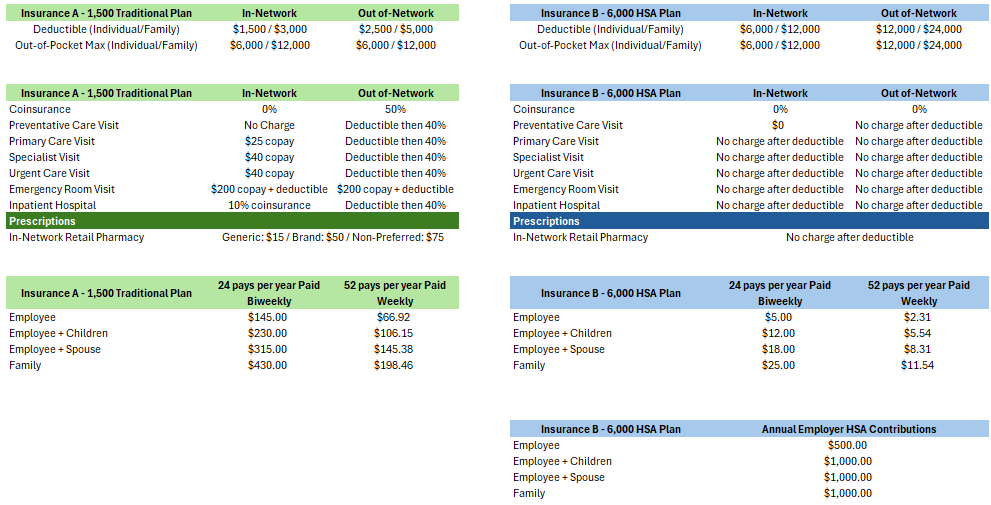
Using another fictitious example, let’s visit Sheldon Plankton who is reviewing his 2027 Employee Benefits Package with The Chum Bucket Restaurant Group, LLC (CBRG). CBRG offers their employees two health insurance options with the embedded features. Sheldon has a wife Karen and one child Chip, so he would be enrolling in a Family plan. He has heard about the benefits of using a HDHP/HSA from his industry friend Eugene, but he does not know how to make a fair comparison to staying on a traditional heath plan. To do so, let’s review their expected health care needs, compare monthly premiums, scenario analysis max out of pocket costs, and finalize by everything together.
Expected medical needs
First, let’s review his family’s current expected medical needs. Sheldon is a healthy 32 year old who does not smoke or drink. He exercises regularly, eats a balanced diet, and outside of routine checkups he does not require much care or medication. His wife Karen is also 32 years old and visits a few specialists per year, but is otherwise healthy like her husband. She does take a daily prescription however for her elevated cholesterol levels. Their son Chip is 5 and does not require specialist care or medication.
Monthly premiums
Sheldon gets paid Biweekly, so let’s take the premium in the table and multiply by 24 to find the total cost just to have the plan

Quite some difference. Clearly, I think we can see which wins in this scenario.
Medical costs
Using their expected level of care, let’s design a base case scenario. For simplicity, I am going to assume that Sheldon and his family live in an area where they have more access to in network care.
Let’s assume
1. Sheldon has one preventative care visit, and an urgent care visit after doing some yardwork.
2. Karen also has a preventative care visit, 2 specialist visits, and her monthly medication.
3. Young chip takes his preventative care visit and another primary care visit to his pediatrician when he gets a cold in the winter.
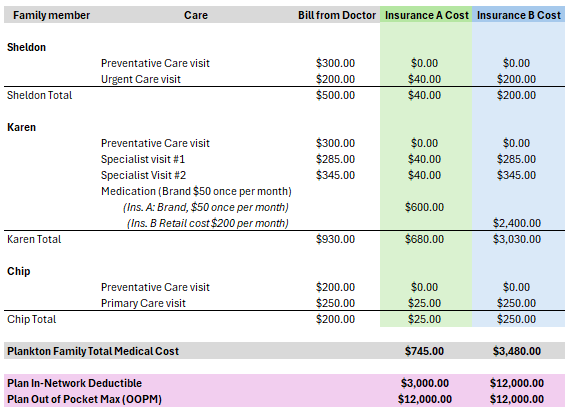
Thanks to the co-pays rather than the full cost of the visit, the traditional health plan offers predictable payments and lowers costs leading to savings here. Note that the total cost of care is still below each plans deductible and OOPM, so you can consider this a fairly inexpensive health care year.
Employer incentives
Remember from our original table that The Chum Bucket Restaurant Group (CBRG) will contribute $1,000 to a Family’s HSA account, so if the Planktons were to chose this health insurance plan option, we could reduce the total medical costs by this amount.
In our example, CBRG does not offer this option to Insurance A – the Traditional Plan
Tie the base case all together
To summarize the analysis we did above into one picture to see the total expected medical costs for premiums + care, see the below table.
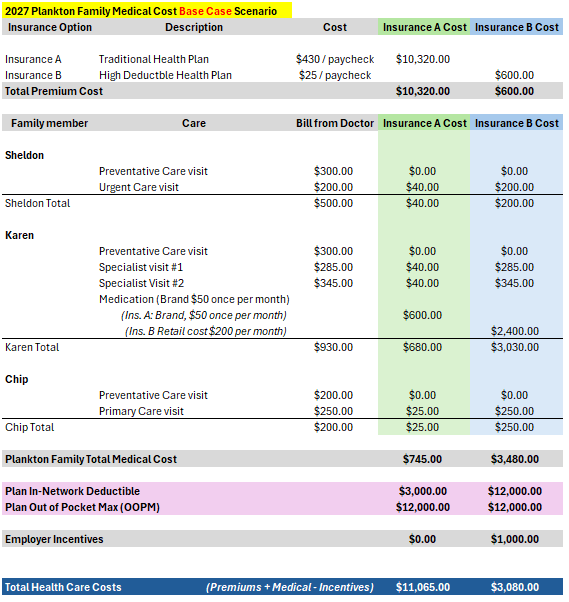
By the looks of it, choosing the HSA option here will save the Plankton family money. And the best part about this is if the family is coming from a Traditional plan and is used to paying close to $11k for care in a year, the family can use the $ difference between the plans ($11,615-$3,080 = $8,535) and invest that into their HSA without feeling a difference in their monthly cash flow!
Low and High Scenarios
In addition to our base case, let’s now look at both extremes of the spectrum and take a no health care needs year, and a catastrophic care year. Starting with the no health care needs year, outside of 1 preventative care appointment each, you can expect the below.
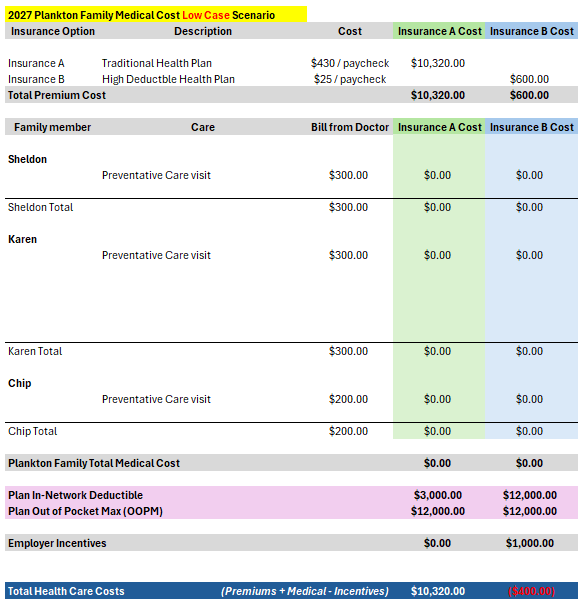
The way this plan currently stands, you can consider these your “floor” healthcare costs. For the pleasure of having coverage, you can expect to pay at least $10,320 for Insurance A even if you don’t use it! And yes, that negative sign is supposed to be there for the HDHP option. Since the premiums only cost you $600, you did not have any medical costs, and your employer paid $1,000 into your HAS, you actually made $400! Woohoo!
On the flip side, let’s look at a scenario where there are major medical needs for the family. Lets assume Sheldon keeps his original medical needs in the base scenario. Karen now is pregnant and will delivery the baby in 2027 and she stops her medication in preparation. Last young Chip takes a major fall on a skateboard at his local Mega Ramp and goes to the emergency room for surgery and care.
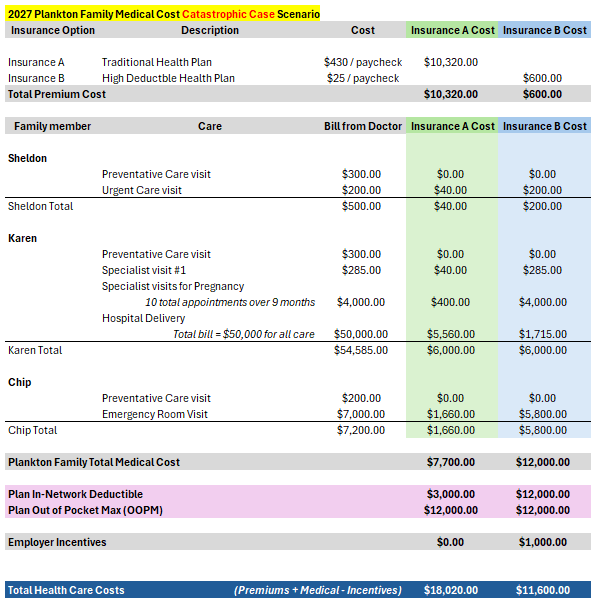
Since we are getting in the weeds here, let me clear up the math on some costs within Insurance A. Starting with Karen, thanks to frequent OB/GYN appointments, ultrasounds, and the outrageous cost of childbirth in this country, she should expect to get pretty close to her individual OOPM figure. Starting with her specialist visits, her first appointment cost of $40 and 10 pregnancy related visits (not including prenatal visits which count as preventative care) at $40 a piece bring her pre pregnancy costs to a total of $440. This is subtracted from her deductible of $1,500, leaving $1,060 still to be spent. After she gives birth that costs $50,000, we subtract the remaining $1,060 to fully meet the deductible, leaving $48,940 subject to the coinsurance rules of the plan. Insurance A has a 10% coinsurance feature (up to the OOPM), so this is equal to $48,940 * 0.10 = $4,894 as her portion of the delivery costs. BUT her OOPM is only $6,000, so $6,000 - $1,500 = $4,500, leaving this as the total cost of her hospital delivery charge, + the $1,060 that went towards the deductible.
The final calculation looks like this:
Karen’s Total medical cost = $440 in pre pregnancy costs + $1,060 in delivery deductible costs + $4,500 in delivery coinsurance to reach the OOPM = $6,000
For Chip in the Insurance A option, he will not be responsible for the full $7,000 bill. First, we subtract the $200 for the emergency room co pay. The remaining $6,800 balance then has $1,460 subtracted from it to (because his dad already satisfied $40 of it through his urgent care visit) to satisfy the family deductible between he three of them. Thanks to the 0% coinsurance clause, the remaining $5,340 will be covered 100% by the insurance company, while Chip’s parents will only need to pay $1,660. Simple right?
Insurance B is a little more simple. Due to the cost of Karen’s pregnancy and delivery and the fact that there are no % coinsurance for care, she is capped at the OOPM of $6,000. This is similar for Chip who’s bill exceeds the Family OOPM, but subtracts $200 from his father’s urgent care visit.
Again, the HSA wins in a total cost comparison here.
I hope your head stopped spinning by now. If it still is, that’s ok that’s what you can hire me for :). To wrap this bad boy up lets go over some common HSA misconceptions that some of you may have.
Common HSA misconceptions
1. I can only use my HSAs for medical expenses
FALSE - Once you turn 65, this account functions like a Traditional IRA for withdrawals. For example, you are 67 and have $10,000 in your HSA. You go see a specialist doctor that costs $5,000, and you want to take $5,000 out for vacation. The $5,000 for care will come out tax free, but the $5,000 will be subject to ordinary income tax.
2. I have an “HSA” through work but cannot carry over a balance
You likely do not have an HSA then. Unlike other employer owned health benefit accounts, such as the Flexible Spending Account (FSA) and the Healthcare Reimbursment Account (HRA), the HSA belongs to the employee and the balance can be carried over to future years. The FSA and HRA are “use it or lose it accounts” where balances disappear at the start of the new year. Most of the time.
3. If I switch from a traditional Health Insurance plan to an HSA (or vice versa) mid year, I can still contribute the max amount based off my family status.
FALSE. Contribution eligibility is based on the number of months you are in the plan. So if you have the HSA plan for only 4 months, and switch to a traditional plan for the remaining 8, you can only contribute the Yearly Max / 4. This also applies to years when you sign up for Medicare. For more details look into the IRS “last-Month Rule”. Don’t get hit with a penalty!
4. There’s no point in using an HSA if I’m going to spend whatever money I contribute, because I’ll lose the investment opportunity.
WRONG. Let’s go back to the Charles E. Cheese example I mentioned earlier, but instead of just a $550 medical bill lets say he has a catastrophic year and plans on spending the full $4,400. By contributing to the HSA, then taking the money out in the same year for the medical expense, he is essentially getting a deduction for medical expenses he would not typically be eligible for. For an individual to get an itemized deduction for medical expenses, the unreimbursed expenses must be above 7.5% of his Adjusted Gross Income (AGI), and your total itemized deductions must be above the standard deduction. Charles currently has an AGI of $100,000 in 2026, so if he has unreimbursed medical bills of $4,400 this would be below the 7.5% floor ($7,500) meaning the deductible amount is $0. And even if he did have unreimbursed expenses of $7,500 or more, its only the amount ABOVE $7,500 that’s allowed to be deducted. Since he does not own a home and is not charitably inclined, he will likely not itemize larger than the current standard deduction of $16,100. By contributing $4,400 to the HSA account, he is adding on this amount to his $16,100 standard deduction to reduce his income, increasing his overall deductions and reducing his income further! I personally like to call this using your HSA “transactionally”, but that’s not an official term. Just something I created.
If you are going through your open enrollment period and would like to create an analysis for you or your family’s situation, please reach out I am happy to help!
Until next time,
Andrew