
Traditional or Roth Contributions: What you need to know
Hello everyone, and welcome back to my second blog. Today we will be discussing the different ways you can contribute to your workplace retirement accounts (i.e. 401(k)s, 403(b)s) and your Individual Retirement Accounts (IRAs for short). This decision rests on picking one of two contribution options; Traditional or Roth.
Traditional contributions are made with pre-tax dollars, meaning this $ amount of earnings is not included in your taxable income for the year. This option is used to defer taxes until withdrawing funds during retirement, when hopefully you are in a lower marginal tax bracket.
Roth contributions are made with post-tax dollars, meaning this $ amount of earnings is included in your taxable income for the year. This option is used to pay tax today, so that way in the future you can withdrawal the money tax free.
Reading the above definitions makes you want to do Roth contributions and fund a Roth IRA right? You pay the tax now, and never have to worry about it again! But not so fast. Lets do a quick illustration
Let’s say you are a farmer and you are getting ready to plant some apple trees. You buy 4 bags of seeds, and due to the inclement weather and poor soil (work with me here), 1 bag of seed is expected to grow 1 apple tree. But growing apple trees without a tax would be outrageous! So the government gives you two options to pay up. Either give them 1 bag of seed up front, or 1 tree after it is done growing as a 25% tax.
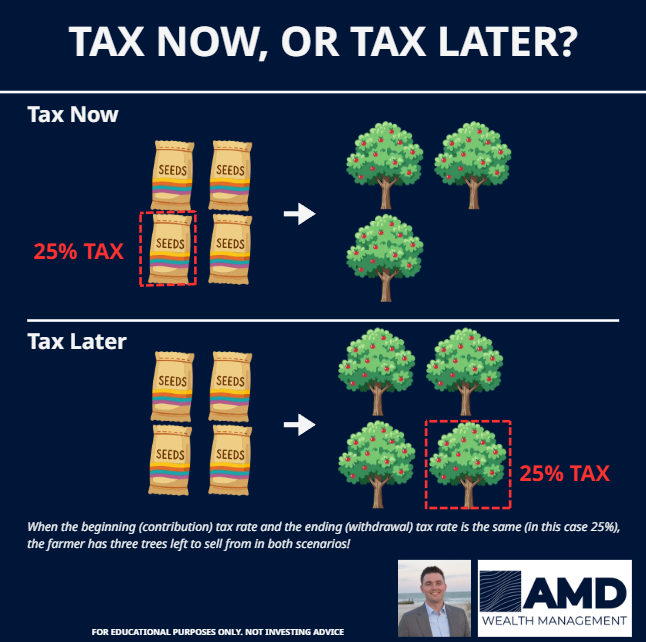
In both the Tax Now and Tax Later scenario, the farmer ends up with 3 trees to sell from, so either way he is in the same exact spot.
Looking for a real world scenario? Lets do some math to see what a single contribution looks like for both Traditional and Roth. Because if we keep a few variables common, the math is the same.
For this hypothetical scenario, I am going to assume variables in the bullets below.
$7,500 one time contribution in beginning of Year 1
7% annual investment growth
10% Federal tax rate on both contributions, and withdrawals (ignoring state tax for simplicity)
Full withdrawal taken on the first day of Year 5
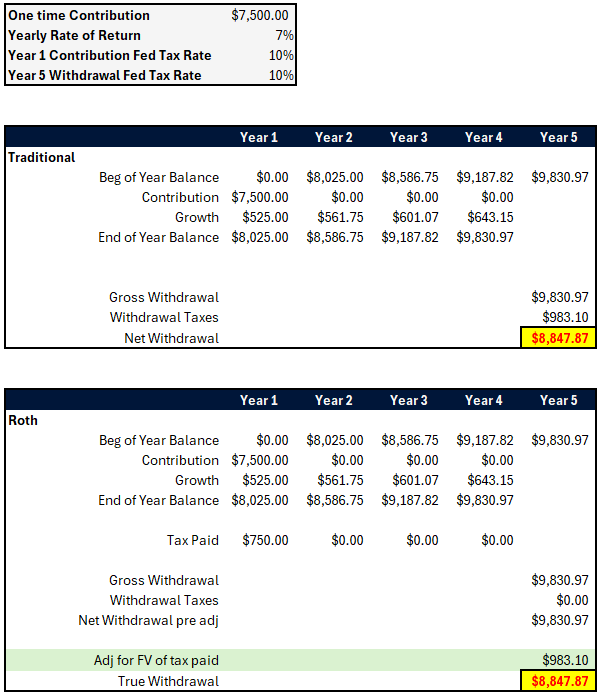
As you can see, both Year 5 withdrawal values come out to be $8,847.87, just like how the farmer only had 3 trees in both of his scenarios.
For those of you asking where the green row is coming from in the Roth table, we must remember there is an opportunity cost to paying those taxes. That is why we need to grow the taxes paid in year one of the Roth contributions. While your Roth account balance matches the Traditional balance, remember you paid taxes earlier out of your pocket instead of getting a deduction from a Traditional contribution. So this is the “future value”, or what those dollars could have grown to, if you did not pay taxes.
“Andrew - c’mon man. I cannot follow this. You got to give me the TL/DR.”
Ok fine. When your contribution tax rate and your withdrawal tax rate are the same, there is not a difference in the balance of the account and the lifetime taxes paid.
Unfortunately, we do not live in a world where we have constant tax rates. Some years we make more, some times we make less, and that is ok. That creates tax planning opportunities!
Now lets take a look at what happens when the tax impact is different between contributions and withdrawals. Below are the 2025 federal tax brackets taken directly from the IRS website. For simplicity I will be looking at the Single and Married Filling Jointly brackets.
Quick Tax Reminder - our federal tax systems is progressive, meaning only income in that specific range is taxed at that rate. For example, if your taxable income for 2025 is $103,350 and you are single, the first $11,925 is taxed at 10%, the next $36,549 is taxed at 12%, the and final $54,874 is taxed at 22%. Sum those up and you now know how to navigate tax brackets!
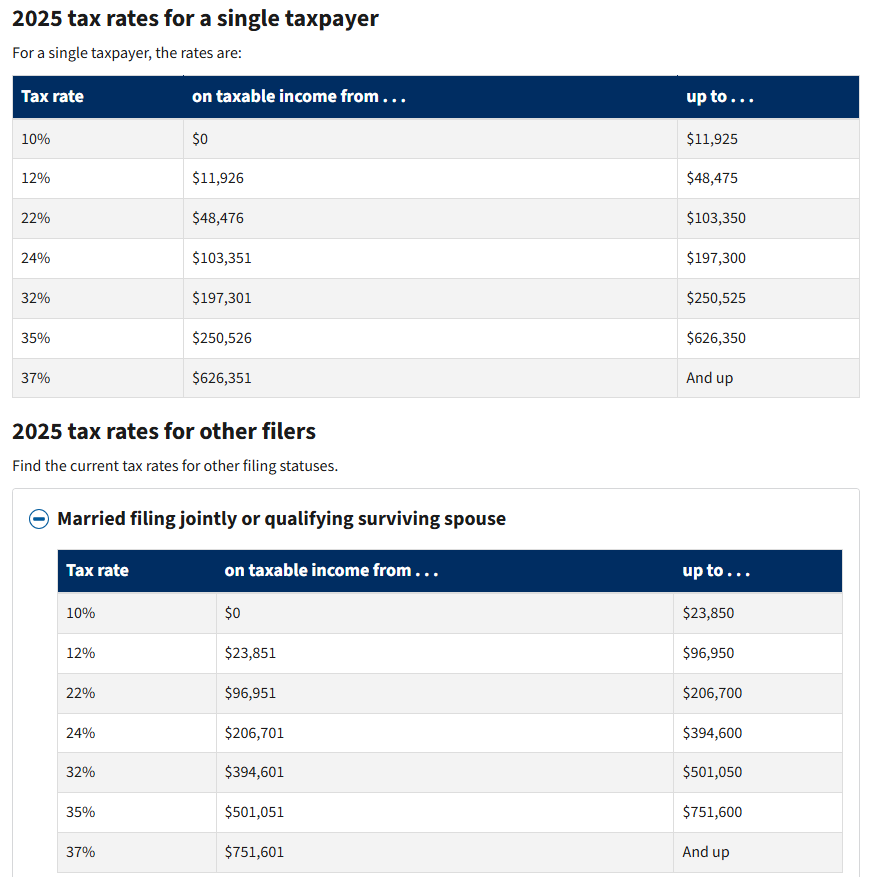
Now let’s look at some more hypothetical examples where the contribution tax rate and the withdrawal tax rate is different
Higher Tax Rate on Contributions / Lower Tax Rate on Withdrawals:
$7,500 one time contribution in beginning of Year 1
7% annual investment growth
32% tax rate on contributions
10% tax rate on withdrawals
Full withdrawal take on the first day of Year 5
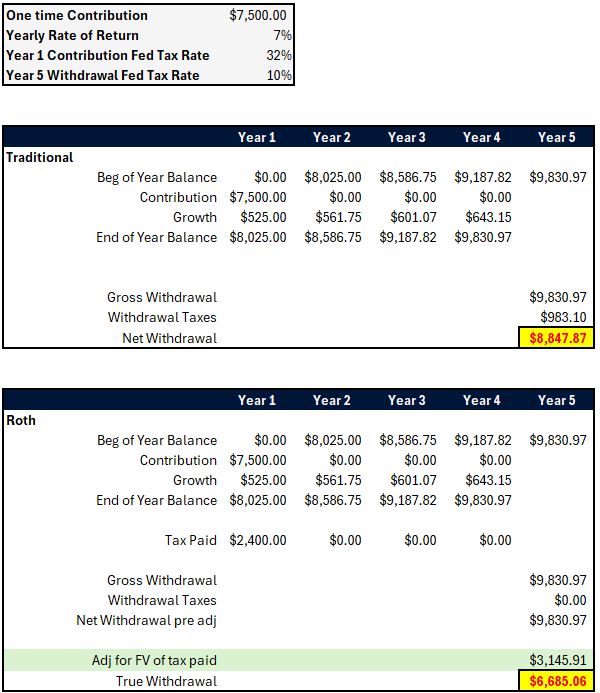
As you can see, the future value of those taxes paid in the Roth table is much higher than the Traditional! You are in a sense $2,162.81 less wealthy than if you took the deduction in your high earning year, and delayed them until you withdrew in a lower tax bracket year.
This also works in reverse. Lets flip around the contribution and withdrawal tax rates
Lower Tax Rate on Contributions / Higher Tax Rate on Withdrawals:
$7,500 one time contribution in beginning of Year 1
7% annual investment growth
10% tax rate on contributions
32% tax rate on withdrawals
Full withdrawal take on the first day of Year 5
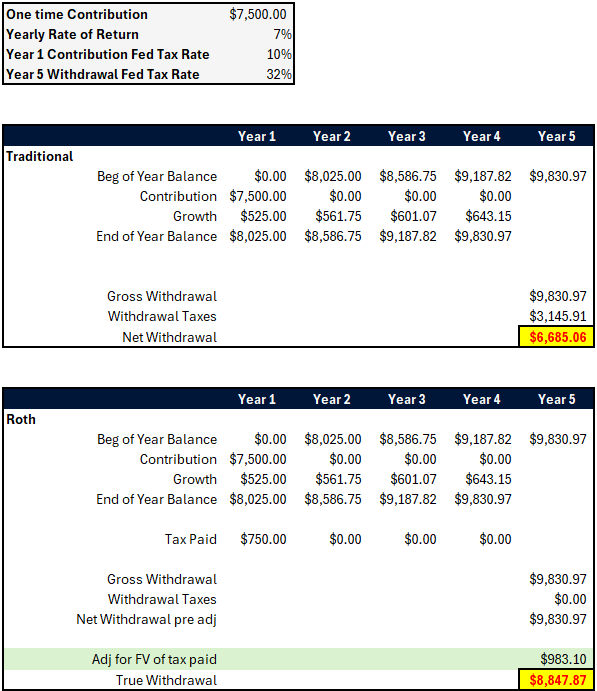
Now the Roth saved the day! You are now wealthier by $2,162.81 in the Roth scenario thanks to paying tax in the low bracket first, and taking out tax free in a year in the high bracket.
I hope by now my extremely simplified examples gave you a better understanding of how Traditional and Roth contributions may impact your tax situation.
Things to take away and think about when deciding on your contributions for the year:
What is my expected marginal tax bracket for this year?
Using all sources of future income (social security, annuities, pensions, etc.) what do I expect my retirement income to be?
Will my beneficiaries be pushed into a higher bracket when inheriting the money, and will I be doing them a favor to pay it now in a lower bracket?
Will my spouse be stuck paying the “widow’s tax” when I pass away?
So next time your uncle, the grocery store clerk, lawyer, or city counsel member tells you “Go all Roth, that’s what I wished I had done when I was young!”, remember they do not know you, your tax situation, and your future earnings so their advice is useless.
Ready to take control of your tax planning? Click HERE to schedule a no pressure New Client - Free Consultation meeting with me to review your contributions!
Thank you,
Andrew
The information presented in this blog is the opinion of the author and does not reflect the views of any other person or entity unless specified. The information provided is believed to be reliable and obtained from reliable sources, but no liability is accepted for inaccuracies. The information provided is for informational purposes and should not be construed as advice. Advisory services offered through AMD Wealth Management LLC, an investment adviser registered with the state of New Jersey.